What is Digital Radiography (DR)?
Digital Radiography (DR) is an advanced X-ray imaging technique in which digital detectors capture X-rays and convert them directly into digital images that can be viewed on a computer within seconds.
(डिजिटल रेडियोग्राफी (डीआर) एक उन्नत एक्स-रे इमेजिंग तकनीक है जिसमें डिजिटल डिटेक्टर एक्स-रे को कैप्चर करते हैं और उन्हें सीधे डिजिटल छवियों में परिवर्तित करते हैं जिन्हें कुछ ही सेकंड में कंप्यूटर पर देखा जा सकता है।)
Basic Principle :-
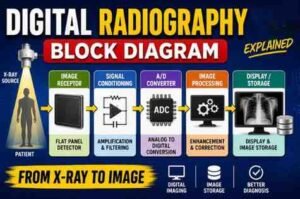
- X-rays pass through the patient’s body.
- A digital detector receives the X-rays.
- The detector converts X-ray energy into electrical signals.
- A computer processes these signals to create a digital image.
- The image is displayed instantly on a monitor.
Types of Digital Radiography
1. Direct Digital Radiography (DDR)
Uses flat-panel detectors.
Images appear almost instantly.
Most common modern DR system.
2. Computed Radiography (CR)
Uses imaging plates instead of film.
Plates are processed in a CR reader to produce digital images.
Advantages-
Faster image acquisition.
Better image quality.
Lower radiation dose compared to many conventional systems.
Easy image storage and sharing.
Digital image enhancement (zoom, contrast adjustment, measurements/window level adjustment).
Disadvantages-
Higher equipment cost.
Requires computer systems and data storage.
Detector damage can be expensive to repair.
Applications
Chest X-rays
Abdomen X-rays
Joints X-rays
Skeletal imaging
Dental radiography
Emergency and trauma imaging
Orthopedic examinations.
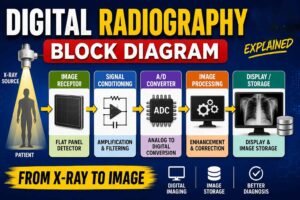
Digital Radiography Block Diagram
X-ray Tube
↓
Patient
↓
Digital Detector
↓
Computer Processing
↓
Monitor Display
Definition: Digital Radiography (DR) is an X-ray imaging system that uses electronic detectors to produce and display digital images instead of traditional film.
I hope guys like this post – What is Digital Radiography (DR)?