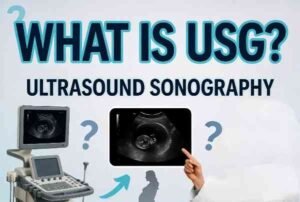
USG (Ultrasonography) is a medical imaging technique that uses high-frequency sound waves (ultrasound) to create images of organs, tissues, and blood flow inside the body.
Basic Principle
A probe called a transducer sends ultrasound waves into the body.
These waves reflect (echo) from different tissues.
The transducer receives the echoes.
A computer processes the echoes and produces real-time images on a monitor.
Why is USG Used in the Medical Field?
1. Pregnancy Examination
Monitor fetal growth and development.
Detect multiple pregnancies (twins, triplets).
Check fetal position and well-being.
2. Abdominal Imaging
Examine the liver, gallbladder, kidneys, pancreas, and spleen.
Detect stones, cysts, tumors, and fluid collections.
3. Cardiac Imaging (Echocardiography)
Assess heart structure and function.
Evaluate heart valves and blood flow.
4. Vascular Studies (Doppler Ultrasound)
Measure blood flow in arteries and veins.
Detect blood clots and vessel blockages.
5. Musculoskeletal Imaging
Examine muscles, tendons, ligaments, and joints.
6. Image-Guided Procedures
Guide biopsies, drainages, and needle placements accurately.
Advantages of USG
✅ No ionizing radiation
✅ Safe for pregnant women and children
✅ Real-time imaging
✅ Non-invasive and painless
✅ Relatively inexpensive and widely available
Limitations( Disadvantage)
❌ Images can be affected by gas and bone
❌ Lower detail than CT or MRI for some structures
❌ Image quality depends on the operator’s skill/USG Machine Quality.
Summary
USG is a safe, non-invasive imaging modality that uses high-frequency sound waves to visualize internal body structures in real time, making it one of the most commonly used diagnostic tools in medicine.
The frequency used in medical ultrasonography (USG) is typically between 1 MHz and 20 MHz.
For example:
A 3.5 MHz probe is commonly used for abdominal imaging because it can penetrate deeper tissues.
A 10–15 MHz probe is used for superficial structures like the thyroid because it provides finer detail.
Since ultrasound frequencies are above 20,000 Hz (20 kHz), they are not audible to humans. Medical USG uses frequencies in the megahertz (MHz) range, which are much higher.
Non invasive – Medical Procedures: Treatments or diagnostic tests that do not require surgical incisions, injections, or the insertion of instruments into the body. Common examples include X-rays, ultrasounds, MRIs, and standard blood pressure checks. This article taken from Google search and books. Thanks like this post – What is USG &It’s Basic Principle